In late August, in Lombard, a suburb of Chicago, e-commerce executives from U.S. food retailers gathered for three days to discuss their current projects. You probably weren’t there, but the report is worth a read: when asked at the start of the event, they ranked AI and automation at the top of their priorities for the next twelve months, ahead of customer loyalty and personalization. But what’s most interesting is how they plan to go about it—and it boils down to two decisions they’ve publicly committed to.
"We Sell Groceries": Why Hy-Vee and Raley's Refuse to Treat E-Commerce as a Separate Business
On the first day of the conference, Dan Gubbins, vice president of e-commerce at Hy-Vee, and Zac Wilson, executive director of digital commerce at Raley’s, described the same approach. At Hy-Vee, this approach involves integrating e-commerce into day-to-day strategic decisions rather than managing it as a separate channel. The formula they use is deliberately simple: the company wants to “just sell groceries.” His counterpart at Raley’s says the same thing in different words—at the end of the day, they’re selling groceries, so they might as well keep the rest simple.
It would be easy to interpret these statements as a renunciation of digital ambition. In fact, the opposite is true, and this stance is more demanding than it appears. As long as e-commerce operates as a separate division—with its own budget, objectives, and decision-making processes—it sets its own priorities, which are often disconnected from those of the broader retail business. Integrating it into day-to-day decision-making means accepting that every decision regarding product assortment, pricing, or promotions must be made with both customer journeys in mind at the same time. This is a more profound reorganization than a mere investment plan.
"Being Where the Customer Shops": When the Shopping Journey Begins Outside the Retailer's Store
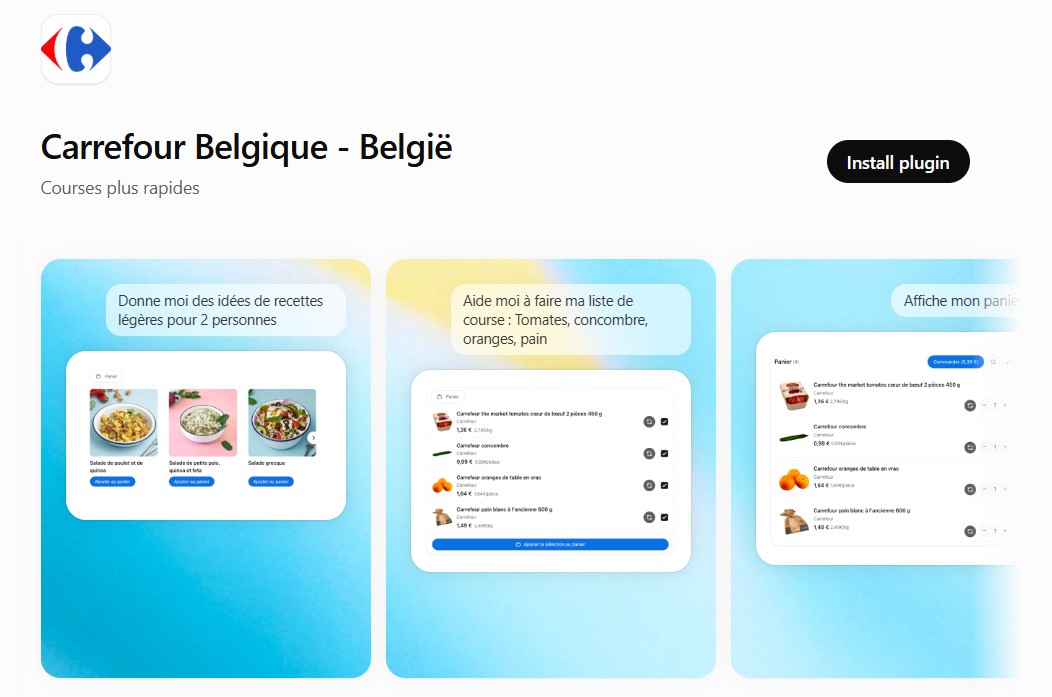
Hy-Vee sums up its second decision in a single sentence: the retailer will be wherever the customer chooses to shop. When first articulated five years ago, this would have referred to the website, the app, and a few marketplaces. By 2026, the list of places where a customer can start their shopping has expanded to include an entirely new category: chatbots, where customers can now fill a shopping cart and schedule a pickup or delivery without ever visiting the retailer’s website. We’ve been operating one such service since late August with Carrefour in Belgium, on ChatGPT.
This is where the statement implies much more than just an omnichannel initiative. Being present wherever the customer shops means accepting that the customer journey begins on a platform the brand does not control. The question that immediately follows is therefore not technical but strategic: in this scenario, who speaks to the customer, in what tone, and who retains the data on what happened? This is our core belief, and it explains why we work on a white-label basis: it’s better for the brand to have its own solution in these spaces than to let a generic assistant come between it and its customer.
Relying on Partners: What the Numbers Say About This Decision
The third point these executives made directly concerns us: Raley's is committed to leveraging partnerships to tap into expertise and accelerate adoption rather than reinventing the wheel.
Three figures illustrate this trade-off. A survey of more than 100 executives and managers in the U.S. food retail sector shows that 59% of them base technology purchasing decisions on return on investment, but 50% prioritize ease of integration—and, most notably, fewer than 10% consider themselves ready to integrate emerging technologies within the next five years. At the same time, 62% of retailers expect their technology budgets to increase by 2026, which is 17 percentage points higher than the previous year.
What these responses describe is a cost that the purchase price does not reflect. A solution chosen for its theoretical ROI but which is costly to integrate into the existing system ties up scarce technical teams for months, and part of that time is paid for twice: once at launch, and once with each update. That is why ease of integration carries almost as much weight as return on investment in these decisions—it is an integral part of them. And that also explains why a larger budget does not automatically translate into more deployments.
What These Decisions Mean for the French E-commerce Sector
On September 24, in Paris, the Food Drive-Thru and E-commerce Workshops will put shopping agents on the agenda, placing them on the same level as product assortment and delivery. The questions raised there will closely resemble those posed by Lombard: to what extent should one maintain a presence in channels one does not control, and what should one build in-house when integration capacity is the limiting factor? The American answers cannot be applied as-is—the French curbside pickup landscape has no equivalent across the Atlantic. But the way these executives framed the issue, starting with what they sell rather than what they could build, is worth listening to.