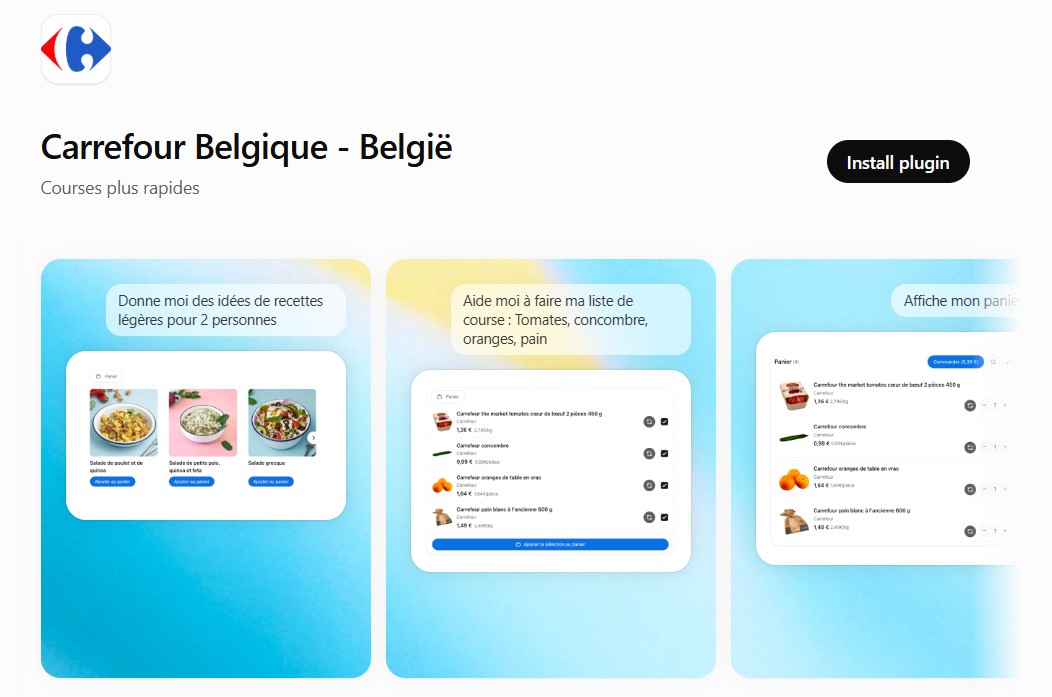
Since August 25, Carrefour customers in Belgium have been able to open ChatGPT, ask for meal ideas for the week, and walk away with a shopping cart ready to be picked up at the drive-through or delivered to their home. This isn’t a demo or a closed pilot: it’s a shopping assistant accessible to everyone, connected to the retailer’s actual product catalog, inventory, and shopping cart. The connector is based on the Mealz.ai shopping agent, and we built it in collaboration with the teams at Carrefour Belgium.
This is the logical next step in a trend the group began in March 2026, when Carrefour became the first European retailer to offer its services through ChatGPT. Belgium is taking it a step further: the conversation no longer ends when the order is placed.
What the connector can do
The assistant covers the entire shopping experience, not just product searches. You can search for an item and add it to your cart, but you can also send an entire shopping list and watch it turn into a cart, ask for recipe ideas, or have a complete weekly meal plan created. The assistant takes food preferences and dietary restrictions into account, remembers household settings, and automatically links the Bonus card so that promotions apply. The customer then chooses to pick up their order at one of the Carrefour Drive locations or have it delivered to their home within 24 hours.
This scope is not merely cosmetic. In the food industry, most purchasing decisions aren’t driven by a specific product but by a craving, a time constraint, or the need to prepare a meal. A sales representative who only knows how to look up items in a catalog is missing the essence of what happens before the shopping cart is filled. This is exactly the approach we’re already using with recipes that can be ordered at several retailers: we start with the meal, and the shopping cart follows.
A hybrid interface, because clicking is sometimes faster than typing
What sets our approach apart can be summed up in one sentence: it’s not “just” conversation. Alongside the text, the agent displays interactive widgets. You can replace a product with a single click, open a recipe card, and check or uncheck items on your list without having to describe in writing what a button does best.
An all-conversational approach comes at an ergonomic cost that quickly becomes apparent when filling a shopping cart: twenty-five items, decisions about brands, sizes, and prices, and substitutions when a product is out of stock. Expressing all of this in natural language takes longer than tapping an item on the screen. A good grocery shopping assistant interface is therefore a hybrid: natural language for intent and inspiration, and direct interaction for fine-tuning. This is what today’s assistant platforms enable, and it’s what we’ve chosen to leverage.
What It Takes Behind the Scenes to Connect a Real Shopping Cart
The difference between a compelling demonstration and a sales representative taking orders lies in the quality of the data. A customer expects the right product, available in their store, at the right price, with the right promotions. This requires matching ingredients and intentions to actual product listings, store by store, across product assortments that vary from one another. This is the work we’ve been doing for seven years: our ingredient-to-product matching algorithm achieves 99% accuracy, as tested across more than 5,000 stores.
There remains the question raised by some media coverage—and it is a legitimate one: What happens to customer data when the customer journey takes place within a third-party interface? Our architecture addresses this through the separation of roles. The language model interprets the request. Orchestration, product mapping, and business logic remain with Mealz. The catalog, shopping cart, and customer data remain with the retailer. No personal data is transferred to the language model. Being present where the customer is does not require relinquishing the customer relationship, provided that this boundary has been established from the outset.
The question is no longer "if," but "who"
The rollout took place without any overhaul of the retailer’s e-commerce architecture, and new features are expected to be announced in the coming weeks. Carrefour is now the first European retailer to have integrated its shopping cart with ChatGPT. It won’t be the last: general-purpose chatbots are becoming an entry point in the shopping journey, and every retailer will have to decide whether to be present there with its own voice, product catalog, and rules—or not at all.
If you're wondering about this for your business, let's talk about it.